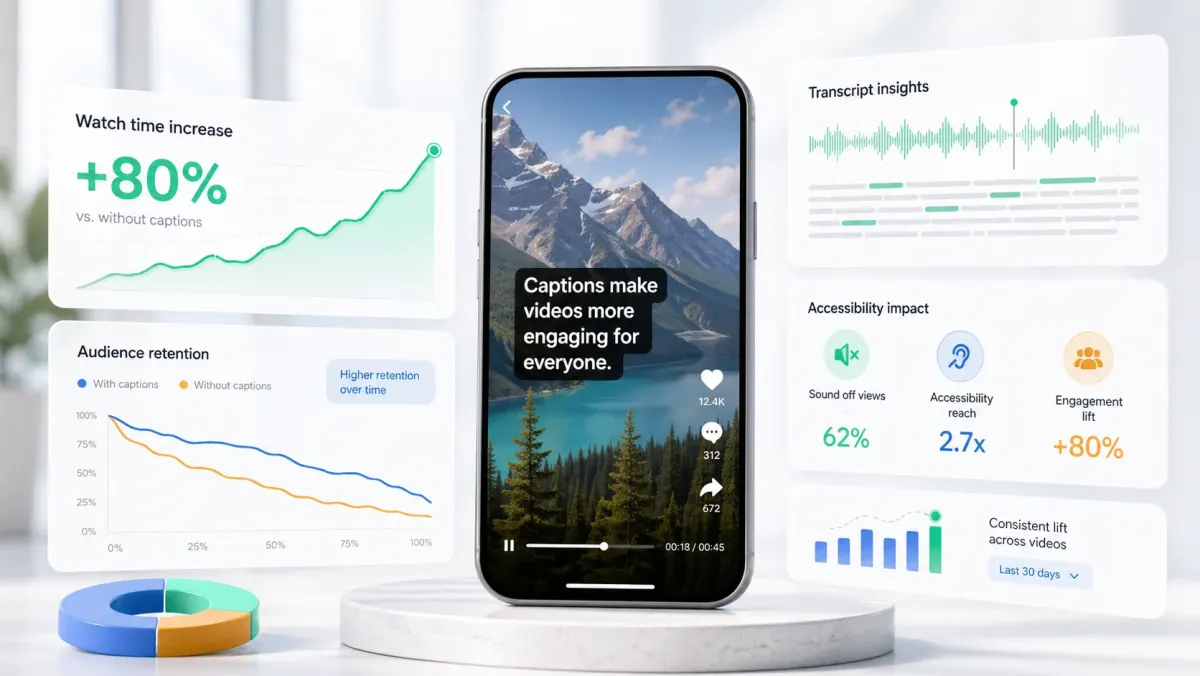
Every social platform now publishes the same finding: captioned video outperforms uncaptioned, by a lot. The headline number bounces between 40% and 80% depending on whose study you read, but the direction is identical across Meta, TikTok, YouTube and LinkedIn. The interesting question isn't if — it's why.
If you understand the mechanism behind the lift, you can predict when captions will help most (almost always) and when they'll do nothing (rare, but real). What follows is the four forces that drive the boost, the data behind each one, and the two ways bad captions reverse it.
Force 1 — Silent scrolling
Roughly 85% of mobile video starts muted. Phones default to silent in public, in offices, in bedrooms. If a viewer can't understand your video without sound, they have one option: keep scrolling. Captions are the only path in for the audience that's already there.
This is the largest single force, and it explains why the lift compounds on platforms with strong silent-scroll behavior (TikTok, Reels) and is smaller on platforms where users actively click into a video (YouTube long-form, podcasts).
Open TikTok with your phone on silent and scroll for 30 seconds. Count how many videos you watched without unmuting. That's the audience your uncaptioned video is invisible to.
Force 2 — Comprehension lift
Reading and listening together produces stronger memory and recall than either alone. This isn't a marketing claim; it's a 50-year-old finding from cognitive psychology called the dual-coding effect. The brain encodes information through two channels (verbal and visual) simultaneously, and recall improves at retrieval because either channel can trigger the memory.
The practical effect: viewers who watch captioned video are more likely to remember your name, your hook, and your CTA. For creators trying to convert viewers into followers, captions are doing measurable work even when the sound is on.
Force 3 — Algorithmic boost
Every modern platform uses the caption track as one of its signals for topical matching. When you upload a video with captions, the platform gets a clean text transcript for free, and it uses that transcript to decide which feeds your video belongs in.
This is why uncaptioned video on YouTube ranks worse for niche keywords than captioned video on the same channel. The platform doesn't have to guess what your video is about; it can read it. Search engines do the same thing — captioned video is the only video that can rank in Google's main search results.
- Captioned YouTube videos get 4–13% more views over their lifetime (YouTube creator data, 2017 study, still cited).
- Captioned video is indexable in Google search; uncaptioned video is effectively invisible.
- On TikTok, captions feed the topic graph used for For You Page targeting.
Force 4 — Accessibility surface
About 1 in 5 people in most Western countries has some level of hearing impairment. They can't watch your uncaptioned video at all, regardless of platform or sound setting. That's a 20% audience cut you're applying every time you publish without captions.
And accessibility isn't just for the deaf and hard-of-hearing. Non-native speakers use captions to follow accents. Parents watching during nap time use captions to keep the volume down. Office workers use captions because they can't unmute at their desk. The accessible audience is a much wider band than the hearing-impaired count alone.
“We see a consistent ~80% lift in average watch time for captioned video, and the lift compounds when the captions are styled to the brand rather than auto-generated.”
— Meta creator research, 2024
Where captions backfire
Bad captions hurt more than no captions. The two patterns that ruin the lift, in order of how often we see them in support tickets:
Timing drift
Captions land 100–300ms after the spoken word. Viewers don't consciously notice; they just feel that the video is 'off'. Watch time drops by 10–25% versus tightly timed captions on the same clip. The fix is word-level timing — sentence-level timing always drifts on fast speakers.
Visual collision
White captions on a bright sky. Yellow karaoke on a beach. Black box covering the speaker's mouth. All three are caused by the same problem: choosing a style for the studio shot and forgetting that real footage has variable backgrounds.
Add a 1–2px black stroke to any caption. It survives every background — sky, snow, white wall — without recoloring per clip. This single change accounts for most of the 'why do my captions look professional now?' feedback we get.
How to measure the lift on your own content
If you want to know what captions are worth on your channel specifically, run a controlled test. Do not eyeball it.
- 01Pick five videos with similar topic and length. Two captioned, three uncaptioned, all posted within a 30-day window.
- 02Compare average watch time and full-watch rate, not view count.
- 03Repeat for the next 30-day window with the captioning ratio reversed.
We've run this test with creators across niches and the floor for the lift is around 30%. The ceiling, on talking-head content with strong dialogue, is closer to 90%. Almost no creator runs this test once and goes back to uncaptioned video.
The compounding effect
The four forces don't add — they multiply. A captioned video gets more views (algorithm), watched longer (silent scroll), remembered better (dual coding), by a wider audience (accessibility). Each force is modest on its own; together they're the difference between a clip that disappears and a clip that earns its way into a second feed.
Captions are the single highest-ROI edit you can make to a short-form video. If you only adopt one habit from this post, make it: never publish a clip without them.